

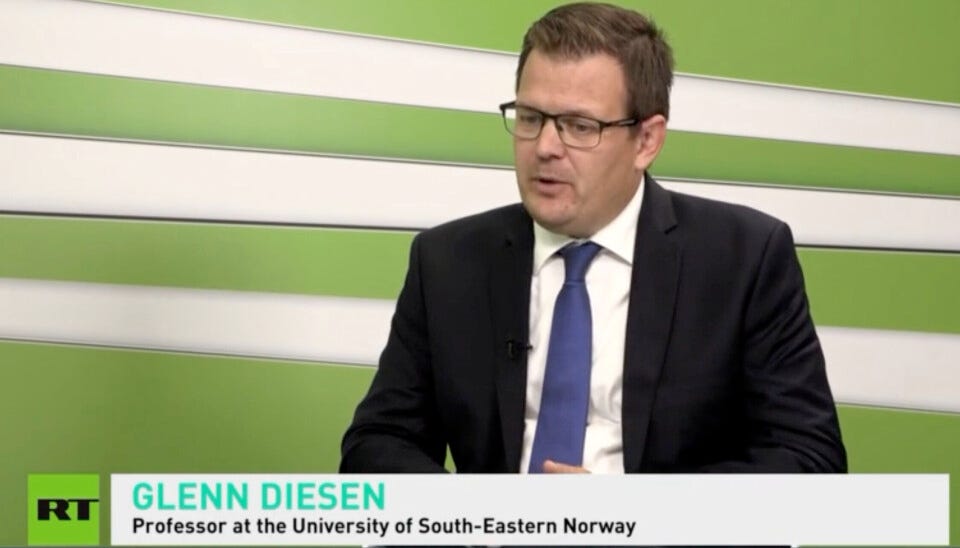
Glenn Diesen became seriously known to the Norwegian audience after he participated in the Debate on NRK (The Norwegian Broadcasting Corporation). For those with insight into Russian information warfare and knowledge of the Norwegian public, Diesen is already a well-known name. For several years, he has promoted the Kremlin's perspectives in the Norwegian and international public. The question is: Is he a deliberate propagandist who spreads disinformation, or a dishonest actor without the ability to criticize sources and critically analyze texts? Whatever the answer, one thing is certain: Glenn Diesen systematically relays the Kremlin's narratives. Here I will present arguments that show that he is a dishonest actor and acts as a mouthpiece for Russian propaganda.
Contribution to the Russian state-run propaganda apparatus Russia Today (RT)
Glenn Diesen has published a number of articles for Russia Today – a propaganda tool controlled by the Russian state. His articles follow a clear pattern: the West is consistently portrayed as oppressive and hypocritical, while Russia is portrayed as the victim or the rational party.
RT is not an ordinary news channel. It is part of Russia's information warfare and explicitly addresses foreign audiences. Unlike NRK, which is also state-owned, RT is directly subordinate to the Russian authorities. NRK has editorial independence and regularly criticizes the Norwegian authorities – something that would have been unthinkable in RT's broadcast surfaces. Criticism of Russian leaders on RT is censored, and can lead to journalists losing their jobs or worse. RT aims to influence public opinion in other countries in favor of the Kremlin.
In 2021, Diesen wrote over 50 articles for RT. Diesen tries to "understand" Russia, but never in a balanced way. It is not a question of understanding different parties in a conflict; It is a matter of justifying Russian actions and downplaying their aggression. He portrays Russia as rational and defensive, and Western actors as provocative and morally corrupt. At the same time, he consistently ignores Ukraine's security needs, history and the will of the population [1].
It is also worth noting that Diesen was getting paid for his work in RT [2]. That in itself is not necessarily disqualifying, but it makes his later accusations against other actors all the more hypocritical. For example, he has criticized the NHC for receiving funds from the National Endowment for Democracy (NED) and called them a propaganda machine [3]. However, unlike RT, the NED does not control the content of the NHC. Diesen's own logic thus backfires on himself: If funding from a state source turns an actor into a propagandist, then he himself is part of a propaganda machine.
Selective use of sources or lack of reading comprehension?
Another serious problem is how Diesen interprets and cites sources. An example is an article he published on his Substack, America's Long War Against Syria [4]. Here he claims that a CIA report from 1986 shows that the US tried to create ethnic tensions in Syria in order to pave the way for regime change. He writes:
«The US began manufacturing ethnic divisions in Syria and laying the foundation for a civil war in the 1980s. A declassified CIA memo from 1986 reveals a strategy for fomenting ethnic divisions in Syria to carry out a regime change...»
But if you look at the memo itself, it does not say this. It discusses possible outcomes if violence were to occur between Alawites and Sunni Muslims, and what political consequences it could have. What the CIA does is analyze the situation and possible development scenarios. There is no indication that they themselves wanted to provoke conflict.
The memo's summary says [5]:
«The sixteen years that Assad has been in power belies the tensions below the surface of Syrian Politics. Syria is governed by an Alawi minority whose rule is deeply resented by the Sunni majority it dislodged from power two decades ago. Factionalism plagues the political and military elite, and the military's strong tradition of coup plotting - dormant since Assad took control in 1970 - cold reassert itself... Tensions between Alawis and Sunnis have been muted in recent years, but the potential for serious communal violence remains. A Sunni rebellion in the late 1970s and early 1980s ended when Assad crushed the Muslim Brotherhood that spearheaded it...»
What is described is a pre-existing problem – not a constructed one. The fact that Diesen presents this as proof that the US created the civil war in Syria shows either that he does not understand what he is reading, or that he deliberately twists the content to support his own narrative.
The same applies to his use of a New York Times article, where he claims that the CIA spent over a billion dollars before 2011 on training rebels who triggered the Syrian civil war:
«The war against Syria was finally unleashed in 2011 as proxies were activated. A New York Times article confirmed that the CIA had spent more than a billion dollars to arm and train rebels against the Syrian government, with much of the weapons ending up in the hands of the jihadist group Al-Nusra that fought alongside CIA-backed fighters. The media sold the events as the government attacking peaceful protesters.»
But if you read the article, it is described that the American program was first proposed in 2012 and approved in 2013, and that the purpose was to counteract Assad's advance – not to start a civil war [6]:
«President Barack Obama had reluctantly agreed to the program in 2013 as the administration was struggling to blunt the momentum of Syrian government forces loyal to President Bashar al-Assad. It soon fell victim to the constantly shifting alliances in Syria's six-year-old civil war and the limited visibility that American military and intelligence officials had over what was occurring on the ground... In the summer of 2012, David H. Petraeus, who was then C.I.A. director, first proposed a covert program of arming and training rebels as Syrian government forces bore down on them... Given the code name Timber Sycamore, the covert program began slowly, but by 2015 the C.I.A.-backed rebel groups had made significant progress against Syrian forces, pushing into areas of the country long considered to be government strongholds. The offensive gained momentum after the C.I.A. and Saudi Arabia began supplying the powerful tank-destroying weapons to the rebel groups...»
Diesen deliberately ignores the context: The protests in 2011 started as genuine, popular demonstrations against a brutal regime. His portrayal casts doubt on the legitimacy of the uprising, portraying the CIA as the main cause of the civil war, while downplaying Assad's use of violence and prolonged repression.
From denial to propaganda – Diesen's role in Putin's information war
On July 17, 2014, the passenger flight MH17, belonging to a Malaysian airline, was shot down over eastern Ukraine. All 298 people on board lost their lives. The shooting took place shortly after Russian-backed separatists, with the support of the Kremlin, had initiated an armed conflict in Ukraine. Russia was quick to deny any responsibility and instead claimed that it was Ukraine that was behind it. In reality, everything pointed in the opposite direction: It was Russian military equipment that was used, and Russian-backed groups that were in control of the area.
Diesen was early to embrace the Kremlin's narrative. Despite the overwhelming amount of evidence – and the fact that the Joint Investigation Team (JIT), a multinational investigative group, concluded that it was the 53rd Anti-Aircraft Missile Brigade from Kursk in Russia that delivered the missile that shot down the plane – Diesen chose to spread doubt [7]. He actively contributed to sowing uncertainty about the investigation and portrayed the whole thing as a politically motivated attack on Russia.
JIT was not alone. Several independent investigations, including a comprehensive report by Bellingcat, came to the same conclusion: Russia was responsible for the shooting. Bellingcat documented, among other things, how the Russian Ministry of Defense had published manipulated satellite images that supposedly showed Ukrainian air defense systems in the area. Through analysis of civilian satellite images, including assessment of vegetation and lighting conditions, Bellingcat was able to demonstrate that the Russian images were falsified [8].
Diesen has tried to discredit Bellingcat, dismissing them as "Western propaganda." But the criticism he makes is razor-thin. He clings to technical objections about image quality in an early version of the analysis, completely ignoring that these weaknesses were later corrected through access to high-resolution images – which strengthened Bellingcat's original conclusion. All this is thoroughly documented in the article Nedskytningen av MH17 og Russlands løgner by Bjørn Johan Berger [9].
Berger also points out how Diesen is extremely selective in who he directs his criticism at. He has shown himself remarkably unwilling to address the countless lies and conspiracy theories that Russia has spread in the wake of MH17. Berger gives several examples of the Russian propaganda machine's operation: Immediately after the shooting, Russian media triumphantly reported that the Donetsk rebels had shot down a Ukrainian military plane [10]. Later, when it became clear that the plane was MH17, the Kremlin's tone changed – and started a campaign of denials and misleading information. Diesen has chosen to ignore all this. He never questions the Russian narratives, and shows no interest in the truth. He only cares about repeating the Kremlin's distorted worldview.
Diesen is an active player in the spread of Russian disinformation. This becomes clear when one reads the article Påstander uten kilder – Professor Diesens metode by Sven G. Holtsmark. Here, among other things, four key points are highlighted [11]: (1) According to Diesen, there exists a "Western narrative" that claims that it is impossible to negotiate with Russia; (2) he compares himself to Machiavelli and portrays himself as a kind of messianic figure who "sees the world as it is"; (3) he argues that NATO expansion is the cause of the war and quotes Angela Merkel and William Burns – but without context; (4) he claims that the United States and Great Britain stood in the way of a peace agreement between Ukraine and Russia.
As for (1), Diesen underestimates that Zelensky was open to negotiations at the beginning of 2022 and wanted direct talks with Putin. Zelensky also signaled that NATO membership could be put aside. Nevertheless, Russia chose to reject these initiatives. It was not the West that rejected negotiations – it was Putin.
Point (3) shows the same pattern: Diesen ignores that Ukraine, under Zelensky's leadership, was willing to abandon its NATO ambitions. At the same time, Russia later changed its justification for the war, emphasizing territorial claims. This clearly shows that the war is about control and imperialism, not about NATO. Nevertheless, Diesen chooses to ignore this. When he quotes Merkel and Burns, he does so in a misleading way. Merkel's concern was that NATO membership could be perceived as a provocation by Russia – not that it was actually a threat. And William Burns warned of Russian reaction, but not of military intervention. Diesen twists this and attributes to them attitudes they have not expressed.
I would also like to highlight the point about NATO expansion, a topic on which Diesen and others with similar views often start their historical understanding either in 2008, when Ukraine and Georgia officially applied for membership in NATO, or in 2007, when Putin in his speech in Munich criticized, among other things, NATO's eastward expansion. What they overlook, however, is that neither Ukraine nor Georgia would seek NATO membership without reason. For several years prior to 2007, Russia had shown particular aggressiveness towards Georgia, which was a major reason why both Georgia and Ukraine turned to NATO as a security guarantee.
In the article, Russia's aggression in Georgia pre-2008 [12], I point to several clear signs of Russia's aggression during this period. It was thus these countries that took the initiative for NATO membership, due to Russia's aggressive role. Among other things, Russia started to build up military bases in South Ossetia, an area they have occupied and where they have at the same time carried out systematic forced Russification. In addition, they significantly increased their military presence and imposed an economic embargo on Georgia. Diesen never mentions this critical backdrop, as he instead continues the Kremlin's disinformation narrative and appears as a particularly dishonest actor.
In point (4), he promotes a classic Kremlin narrative: that the West – especially Boris Johnson – thwarted a peace agreement between Ukraine and Russia. This is a gross simplification. The negotiations in Istanbul in March 2022 were characterized by Russian demands that in practice would have neutralized Ukraine: reduced military capacity – 85,000 personnel, 342 tanks, 519 artillery systems, missiles with a range of no more than 40 km – cession of Crimea, restrictions on arms purchases, and demands that Russian should become the official language [13]. Russia has since gone even further, and now claims more territory than it currently controls. Combined with demands for a reduction in military and territory, it is a recipe that will make it easier for Russia to invade again. This is not the will for peace – it is the will for occupation.
Diesen also does not mention the Bucha massacre, which was uncovered at the same time as the negotiations. The brutality Russia showed there revealed the true face of the regime. A peace agreement with such a regime is difficult to defend. But Diesen ignores this – because it does not fit into his narrative.
Finally, point (2): Diesen's self-image. He appears as an academic version of a Machiavelli, someone who thinks he sees "the naked reality" – but in reality he appears as a spokesperson for an authoritarian and lying-based regime. He spreads Russian disinformation – either consciously or unconsciously – and it is high time that he loses all professional and public credibility.
Reference list:
1. Christensen, L. (04.03.2022). Last year, the Norwegian professor wrote over fifty articles for the state-run Russian news channel RT. Researcher forum. Retrieved from: https://www.forskerforum.no/i-fjor-skrev-den-norske-professoren-over-femti-artikler-for-den-statlige-russiske-nyhetskanalen-rt/
2. Norum, M. L. & Klungtveit, H. S. (22.06.2023). A Norwegian professor had the trip paid for by a Putin-affiliated foundation. Listed as a member of a think tank that is supposed to counteract sanctions. Filter news. Retrieved from: https://filternyheter.no/norsk-professor-fikk-reisen-betalt-av-putin-tilknyttet-stiftelse-fort-opp-som-medlem-av-tankesmie-som-skal-motvirke-sanksjoner/
3. Diesen, G. (16.01.2024). The NHC is a propaganda organization. Steigan. Retrieved from: https://steigan.no/2024/01/helsingforskomiteen-er-en-propagandaorganisasjon/
4. Diesen, G. (17.12.2024). America's Long War Against Syria. Substack. Retrieved from:

5. Classified. (31.07.1986). Syria: Scenarios of Dramatic Political Change. CIA. Retrieved from: https://www.cia.gov/readingroom/docs/CIA-RDP86T01017R000100770001-5.pdf
6. Mazzetti, M., Goldman, A. & Schmidt, M. S. (02.08.2017). Behind the sudden death of a $1 billion secret C.I.A. War in Syria. The New York Times. Taken from: https://www.nytimes.com/2017/08/02/world/middleeast/cia-syria-rebel-arm-train-trump.html
7. Join Investigation Team. (xx.02.2023). Findings of the JIT MH17 investigation into the crew members of the BUK TELAR and those responsible in the chain of command. JIT. Retrieved from: https://www.prosecutionservice.nl/topics/mh17-plane-crash/documents/publications/mh17/map/2023/report-mh17
8. Higgings, E. (08.10.2015). MH17 – The Open Source Evidence. Bellingcat. Retrieved from: https://www.bellingcat.com/news/uk-and-europe/2015/10/08/mh17-the-open-source-evidence/
9. Berger, B. J. (17.07.2023). The shooting down of MH17 and Russia's lies. Minerva. Retrieved from: https://www.minerva.no/propaganda-russland-ukraina/nedskytingen-av-mh17-og-russlands-logner/429464
10. Schreck, C. (15.07.2019). «Birdie» Down: The first, damning hours after MH17 was shot out of the sky. RFE/RL. Retrieved from: https://www.rferl.org/a/when-russia-backed-forces-boasted-they-shot-down-a-ukrainian-military-plane-that-was-actually-mh17/30056279.html
11. Holtsmark, S. G. (15.05.2025). Claims without sources – Professor Diesen's method. Vagant. Taken from: https://www.vagant.no/professor-diesens-metode/
12. Hagen, E. G. (23.03.2025). Russia's aggression in Georgia pre-2008. Substack. Taken from: https://endrehagen.substack.com/p/russias-aggression-in-georgia-pre
13. Colchester, M., Grove, T. & Marson, J. (01.03.2024). Document from 2022 reveals Putin's punishing terms for peace. The Wall Street Journal. Retrieved from: https://www.wsj.com/world/russia-ukraine-peace-deal-2022-document-6e12e093